
Custom Metal Badges: Soft Enamel, Hard Enamel, or Die-Struck?
Those three processes can start with the same logo and produce noticeably different results. The best choice is not simply the one that looks most expensive in a product photo. It depends on how much color the artwork needs, whether texture is part of the idea, how formal the finished badge should feel, and where it will be worn or presented.
In this guide, the phrase custom metal badge refers to a wearable metal pin or emblem made around one approved design. It does not mean a printed employee name badge, event credential, or individually personalized ID card.

What is a custom metal badge?
A custom metal badge is a made-to-order pin or emblem shaped around your artwork. The design may include a logo, mascot, date, title, crest, slogan, or commemorative symbol. Unlike a stock badge with a printed sticker added later, the metal lines, recessed areas, and outer shape are planned as part of the design.
The word badge is broad. A school might use it for a leadership pin, a company for a service award, a club for a membership emblem, and an event organizer for a limited-edition keepsake. These projects can use the same basic product format while needing very different finishes.
That is why the process decision should happen before the artwork is finalized. A soft enamel layout needs metal boundaries between color areas. Hard enamel also depends on clearly separated sections, but the final surface is polished flat. Die-struck work can rely on fine metal relief and lettering without enamel fill. Choosing the process early prevents the design from being forced into the wrong visual language later.
Choose soft enamel for bold color and tactile detail
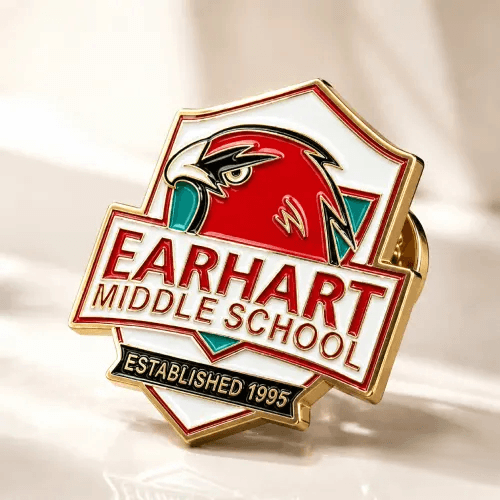
On a soft enamel badge, the enamel color sits slightly below the raised metal outlines. Run a fingertip across the face and you can feel the divisions between the colored areas. That texture is not a flaw. It is the defining visual and physical feature of the process.
Soft enamel works well for mascots, club marks, event logos, character artwork, and promotional pins with several solid colors. Raised borders can make a simple illustration feel more dimensional without requiring fully sculpted 3D modeling.
The main design constraint is color separation. Each enamel area normally needs a metal boundary, so gradients, watercolor effects, and tiny color transitions may have to be simplified. Very small text can also lose clarity once it is converted into metal lines.
An optional clear epoxy coating may protect and smooth the top of some soft enamel designs, but it does not turn soft enamel into hard enamel. The underlying production method and visual depth are still different. If a completely level, polished face is the goal, hard enamel is the more direct choice.
Choose hard enamel for a smooth, polished face
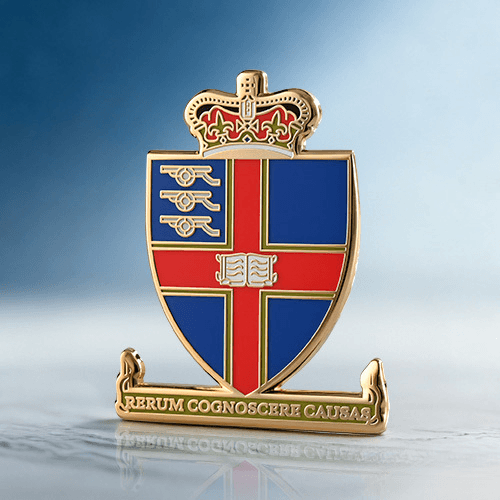
Hard enamel badges are filled and polished so the colored sections sit nearly level with the metal lines. The front feels smooth rather than recessed. Under direct light, the polished surface can give crests, formal logos, and geometric designs a clean presentation.
This process is a strong candidate for corporate recognition, anniversary emblems, association pins, awards, and retail pieces where a neat face matters. It is especially effective when the artwork uses solid shapes, controlled color blocks, and crisp outlines.
Hard enamel is not automatically the right answer for every premium project. If the design depends on pronounced texture, deep relief, or an aged all-metal appearance, polishing the surface flat may remove some of the character you want. As with soft enamel, extremely complex gradients and photographic shading usually need a different production route or artwork adjustment.
Choose die-struck metal when color is unnecessary
Die-struck badges use raised and recessed metal to form the design. Without large enamel color fields competing for attention, lettering, borders, dates, and symbols can become the main visual language. Different surface treatments may increase contrast between polished and recessed areas, depending on the exact project and available finish.
The result often feels traditional, commemorative, or institutional. It suits heritage marks, years-of-service badges, membership emblems, restrained corporate identities, and anniversary pieces where metal is part of the message.
Die-struck does not mean plain. A well-designed relief can have depth and detail, but it works best when the artwork can be understood through shape, line, and contrast. A logo that depends on several brand colors may lose too much information if all color is removed.
Soft enamel vs. hard enamel vs. die-struck
The following comparison is a practical starting point. It is not a substitute for reviewing the actual artwork, because line thickness, size, plating, and attachment can change how a design reads at pin scale.
Let the artwork make the first decision
A useful way to choose a process is to temporarily ignore the product name and inspect the artwork. Ask what carries the identity of the design.
- If color carries the identity: start with soft or hard enamel. Compare whether a textured or smooth face better supports the intended use.
- If metal lines carry the identity: die-struck may be the clearest route, especially for dates, lettering, seals, and traditional marks.
- If sculpted volume carries the identity: consider a 3D cast approach instead of forcing rounded contours into flat color fields.
- If gradients or photographic detail carry the identity: ask about a printed process. Enamel is best at solid, separated color areas.
Size matters as much as process. Text that looks large on a monitor can become unreadable on a one-inch object. Thin gaps may close visually, and several small color areas may merge when viewed at normal distance. Before approving a proof, display it close to the intended finished size as well as enlarged.
Keep the hierarchy simple. Decide what a viewer must notice first, what can be secondary, and what can be removed. A clean emblem with one strong symbol and legible wording often performs better than a complete poster reduced to pin size.

When 3D cast may be the better route
A 3D cast badge can represent rounded contours, layered relief, and sculpted subjects that do not fit neatly into flat enamel sections. It is useful for animals, faces, dimensional objects, and decorative forms where depth is part of the artwork. Confirm the exact process after the design has been reviewed.
Which metal badge process fits your use?
Do plating and attachment change the decision?
They can. The metal finish affects the contrast around enamel colors and the overall mood of a die-struck design. A bright metal tone can make color feel crisp, while an antique-style treatment may emphasize recessed detail. Availability and suitability should be confirmed for the specific artwork rather than assumed from a reference image.
The attachment should match how the badge will be worn. Consider the garment or surface, expected movement, badge size, and whether the back needs to sit as flat as possible. If the badge is part of a presentation set, packaging and backing-card space may also influence the final size and post position.
These choices are easiest to review together. A large or uneven shape may need more than one attachment point to reduce rotation, while a small simple badge may not. Include the intended use when requesting a proof so the construction is not chosen in isolation from the real application.
What to prepare before ordering custom metal badges
You do not need to redraw everything as production art before asking for help. A clear project brief, however, makes the proof stage faster and more useful.
Do not rely only on a process name. Send the artwork and describe the intended result. A designer can then identify where lines may need to be strengthened, colors separated, or small details simplified.
How the MZIHO custom order process works
A digital proof is a production plan, not a physical sample. Screens also display color differently from enamel and plated metal. Review the proof for structure and clarity, and allow for reasonable material and display variation in the finished piece.
For a broader look at artwork planning, read the custom pin design and process guide. To compare available product routes and submit a design, visit the MZIHO custom lapel pin collection.